
8th July 2026
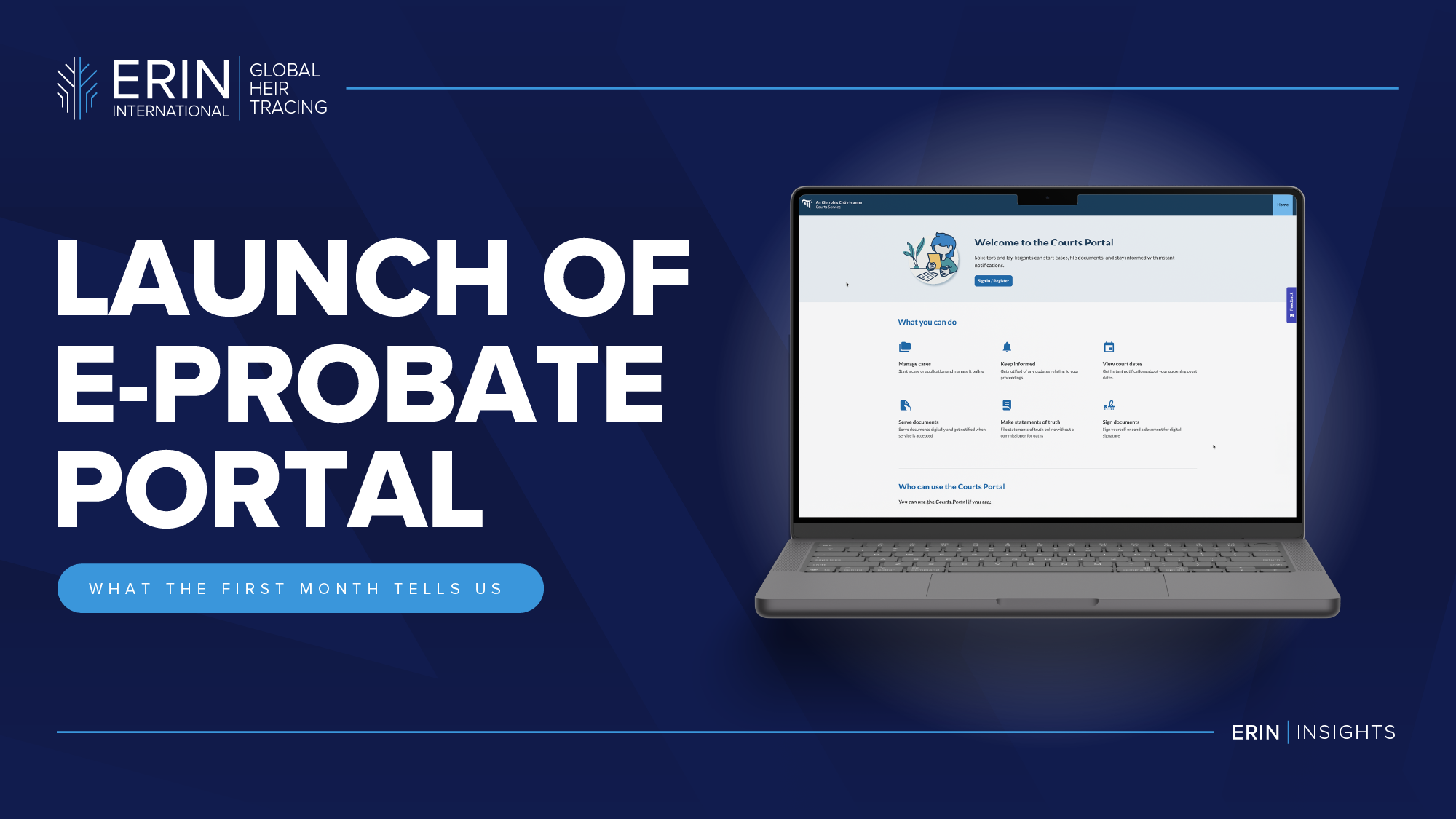
Since 2nd June 2026, solicitors across the Republic of Ireland have been able to apply for grants of probate online through the Courts Service’s Courts Portal at portal.courts.ie. The paper process has not disappeared, but for the core body of applications it now has a faster, integrated alternative. One month on, the early results are encouraging, and the appetite among practitioners for clarity on what the change means in practice has been considerable.
On 2nd July 2026, exactly one month after the nationwide launch, more than 1,500 solicitors registered an Erin International webinar on the e-Probate Portal, hosted by our founder Padraic Grennan. We were joined by Eve Farrelly, Assistant Probate Officer, and Jim Dalton, who leads the Courts Portal team within the Courts Service. Over 100 questions were submitted during the session, more than could be answered in the time available. We have collated those questions and have forwarded them to the Courts Service so that practitioners receive authoritative answers on the new application process.
This article sets out what is now live, what the data is telling us after the first month, and where the online process changes what solicitors need to prepare before they file.
What is now live
The nationwide roll-out currently supports solicitor applications for grants of probate only. That is the deliberate starting point. The Courts Service piloted the portal with a small group of Dublin solicitors from October 2025, received more than 100 applications, and refined the system on the basis of that feedback before opening it to the profession nationally.
There are defined restrictions on who can apply online. An application can proceed through the portal only where all applicants are over 18 and can make their own decisions, the person died on or after 5 December 2001, the deceased was domiciled in Ireland, no grant has already issued for the estate, and all applicants are named as executors in the will. Applications that fall outside those parameters, including foreign domicile estates, secondary grants, and applications involving attorneys or personal applicants, continue on paper for now.
The roadmap was set out clearly during the webinar. Support for grants of administration in intestate estates is expected during Q3 2026, subject to court rule changes that are in progress. Personal applications are further out, because they require legislative change to authorise the use of the PPSN for identity verification. There is, as Jim Dalton confirmed, no immediate plan to withdraw the paper option.
The Statement of Truth replaces the Oath
The most significant procedural change is the replacement of the Oath of Executor with a Statement of Truth. Order 40A of the Superior Court Rules provides that, where an affidavit is required or permitted in proceedings authorised for digital delivery, a Statement of Truth satisfies the obligation to file an affidavit. For online applications, the Statement of Truth of Executor replaces the oath.
The practical consequences are worth noting. The Statement of Truth is signed digitally through the portal and does not need to be sworn or witnessed, which lends itself to a fully digital workflow. It carries real weight: making a false statement can be subject to an offence of equivalent legal seriousness to perjury. Padraic Grennan described the Statement of Truth during the session as potentially a game changer in terms of the rejections that historically arose on the oath, and the feedback from the Courts Service supports that view.
What the first month of data shows
The early indicators are positive, and the headline figure that matters to most practitioners is turnaround time.
Eve Farrelly told the webinar that, in the absence of queries, the office is currently turning grants around through the portal in three to four weeks, against a paper turnaround presently hovering between ten and eleven weeks. The office aims to assess a portal application within seven to ten working days of receiving it, with an overall target of issuing grants within about twenty business days in the majority of cases. On the morning of the webinar, Jim Dalton confirmed that 316 applications had been filed through the portal, with in the region of 140 grants already issued.
The reason the office can move faster is a reduction in errors and queries. Probate Officer Anne Heenan, speaking at the launch, noted that the volume of errors and mistakes in hard-copy applications increases the office’s workload and lengthens turnaround times, and that online applications have shown a reduction in those errors. Two design features drive that improvement. The portal integrates with Revenue to pull information from the Notice of Acknowledgement, reducing repeat data entry. It also generates the title in the Statement of Truth automatically from the answers given about applicants and executors who are not applying, which addresses one of the most common historic sources of requisition.
The friction points solicitors raised
The volume of questions during the webinar reflected genuine uncertainty about practical edge cases, and several themes recurred.
Digital signing was the most common concern. Because the Statement of Truth is signed digitally, an email address and mobile phone number are required for each applicant, and for a medical practitioner where a Statement of Truth of Testamentary Capacity is needed. For elderly clients, or clients who are not comfortable with digital signing, that requirement can be a barrier. The current position is that where an applicant cannot provide an email address, the application proceeds on paper. The Courts Service confirmed it is actively examining options for these cases.
Several other points of detail were clarified. The original will, together with any codicils and maps, must still be posted to the Probate Office under a printed cover sheet, and the office does not begin its assessment until the original will is received. The applicant, not a Commissioner for Oaths, signs the back of the original will. On testamentary capacity, the established position continues to apply: a Statement of Truth of Testamentary Capacity is generally required where a cognitive condition is recorded and the will was made within five years of death for a solicitor-drafted will, or within ten years for a homemade will, and the portal has been refined to capture the duration of illness more precisely. Practitioners with a paper application already lodged but not yet assessed can, in defined circumstances, withdraw it and refile through the portal.
Where the portal validates, and where it does not
For probate and private client solicitors, the distinction that matters most is between what the portal checks and what it does not.
The portal is well designed to enforce internal consistency. It validates eligibility against the online criteria, reconciles names, addresses, and place of death against the death certificate and the Revenue record, and constructs title from the information the solicitor provides. These are meaningful safeguards, and they are the reason query rates are falling.
What the portal validates, however, is the application as presented. It does not, and is not designed to, confirm that the family structure underlying the application is complete. The entitlement of a beneficiary under Irish succession law is established by their existence, not by whether the family or the papers happen to mention them. That obligation is unchanged by the move online. What has changed is that accuracy and consistency are now checked at the point of filing, which raises the visibility of any gap in the underlying information rather than leaving it to surface after the grant has issued or after distribution.
This matters most in two situations that the profession will meet more often as the system matures. The first is the cross-border estate. Few Irish estates are entirely domestic. Emigration across the twentieth century means beneficiaries are regularly located in the United Kingdom, the United States, Australia, Canada, and beyond, holding entitlement under Irish succession law regardless of where they live. The second is intestacy, where the class of beneficiaries is fixed by the Succession Act 1965 and the administrator’s task is to identify every member of that class, not only those known to the family. With intestacy support expected on the portal in Q3 2026, the completeness of beneficiary identification will move from a paper-era concern to a live one for portal users.
In both situations, identifying and verifying beneficiaries requires access to records across jurisdictions and a methodology for using them correctly. That work sits with the personal representative and the instructing solicitor, and it is not resolved by a faster filing process. Where a family tree is incomplete, where a relative emigrated decades ago, or where the record is simply uncertain, independent verification prepared to a documentary standard protects the solicitor’s professional position and supports a confident distribution decision.
The direction of travel
The online probate system is a genuine improvement, and the first month’s data supports that assessment. Faster turnaround, Revenue integration, automatically generated title, and a reduction in avoidable queries are real gains for solicitors and their clients, and the Courts Service has been measured and responsive in how it has rolled the system out. As Erin International CEO Padraic Grennan put it, this is a substantial undertaking that will continue to evolve over the coming years.
For probate and private client solicitors, the practical message is twofold. Register on the Courts Portal and begin filing, because the efficiency gains are real. And treat the portal’s checks as validation of the application, not verification of the beneficiaries behind it. The system is designed to get the paperwork right. Ensuring the class of beneficiaries is complete, particularly in cross-border and intestate estates, remains a matter of independent investigation and documentary evidence.
Erin International works alongside probate and private client solicitors throughout Ireland on independent beneficiary verification: structured genealogical research, conducted independently of what the family reports, and documented to a standard that will withstand scrutiny from the Probate Office and the courts. If the move online is raising questions your current information cannot answer, our Irish team is available to discuss them.
Erin International is a probate research firm specialising in the location and verification of missing beneficiaries and next-of-kin in Irish estates with international dimensions.
Dublin, London, New York.
Sources
- Courts Service, “Probate online to go live for solicitors nationwide on the Courts Portal from 2 June 2026”, courts.ie
- Law Society Gazette, “Online probate system now fully live”, 2 June 2026
- Law Society Gazette, “Up to 140 probate grants issued by online portal”, 22 June 2026
- Erin International eProbate webinar, 2 July 2026 (Eve Farrelly, Assistant Probate Officer; Jim Dalton, Courts Portal team lead; hosted by Padraic Grennan). Presentation and transcript on file.
- Order 40A, Rules of the Superior Courts